
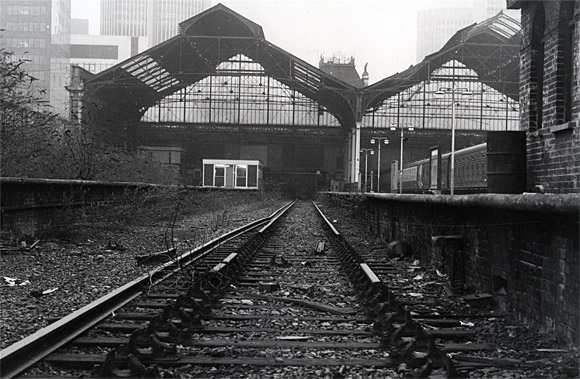
Closed in 1986 after a long and lingering death, the once bustling terminus at Broad Street was in a parlous state at the end, with its extensive canopies cut back, rails lifted and abandoned platforms sprouting weeds and small trees.
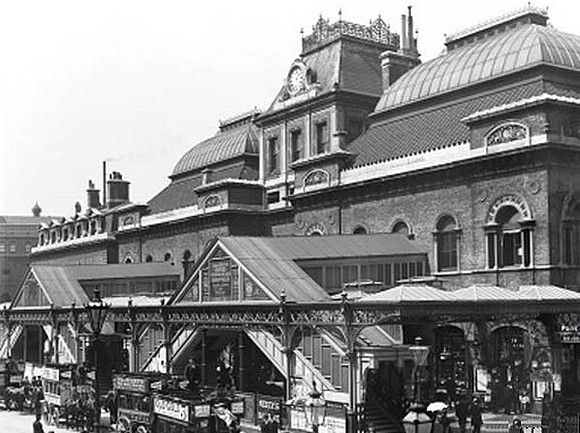
The station was built in a French Renaissance style in 1865 for the North London Railway to a design by William Baker.
Various alterations were made over the years, including the four stairways bolted on to the front, as seen in this 1898 postcard view.
Third busiest station
At the beginning of the 20th century, early Edwardian trainspotters would have been spinning with smoky excitement, watching more than one steam train per minute puffing in or out of the station.
With over 27 million passengers using the terminus in 1902, Broad Street was London’s third busiest station, with only Liverpool Street and Victoria carrying more passengers.
Decline
Competing bus, tram and Tube services hit the station hard, and major WW2 bomb damage led to the main part of the station being closed in 1950.
By the 1960s, all but two platforms remained in use, catching the eye of the evil Dr Beeching, who only failed to close the station after locals lobbied the government.
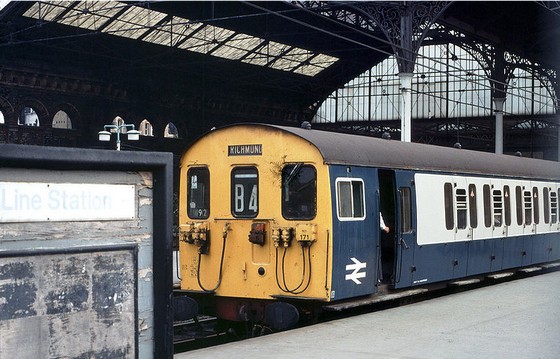
A Broad Street – Richmond train in old BR blue and grey livery waits to depart Broad Street (photo: Wikipedia).
Writing in about London’s Terminals in 1973, Sir John Betjeman painted a grim picture of the station’s plight:
In the ‘sixties, the magnificent iron roof over the train shed at Broad Street was removed. The large Lombardic buffet and the shops for City clerks were shut down, and in 1970 the scale model 4-4-0 engine, whose wheels went round if you put a penny in the slot, was either removed or stolen. Standing in the empty concourse at Broad Street today, one has a feeling of its former greatness.
A few steps back from the concourse will take you into what was once an enormous booking hall, whose timber roofs tower above the station shops. Along on the concourse now stands the 1914 War Memorial of the North London, a miniature version of the Cenotaph in Whitehall. Beyond it, incongruous and ridiculous, in red brick with pavement-light windows is a streamlined booking office for the few passengers who use this potentially popular line. May God save the Old North London!
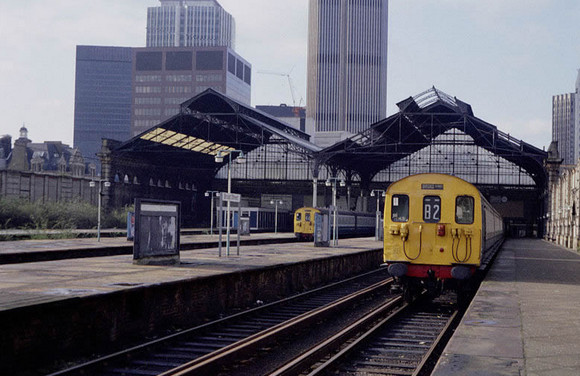 Broad Street, 1983 (photo: Wikipedia).
The end
The station gamely hobbled on, but by 1985 just 6,000 passengers per week were using the station, with the morning rush hour more of a gentle saunter, with just 300 souls shuffling along its decrepit platforms.
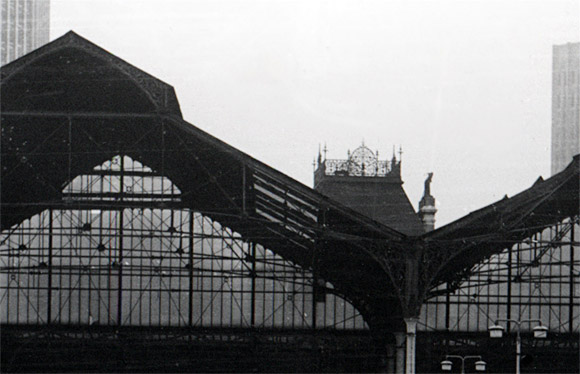
The once-delightful station buildings were flattened in November 1985, with the site now playing host to the architecturally undistinguished Broadgate office and shopping complex.
Fact! Paul McCartney’s pretty-much-awful ‘Give My Regards to Broad Street’ film and soundtrack album was inspired by the station.
urban75 feature
[wikipedia feature]
[Deserted Stations]
Related posts:
 Cardiff Queen Street station – history and new platforms update
 In photos: the magnificent curves and Victorian architecture of York railway station
 Banbury railway station: fog, semaphore signals and trainspotters
 Birmingham New Street named as Britain’s worst railway station
 Coborn Road railway station: a long abandoned East London station
 Cardiff Queen Street railway station modernisation adds new platforms for increased Valleys traffic
 London Victoria railway station – the refurbished roof sees the light
 The 39 steps, Brixton railway station

I remember this station well and the trains in the photo above. My Dad and I used to catch this train from Gospel Oak to go fishing at Richmond and IIRC Windsor, when we’d change at Richmond.
I also remember taking these trains from this station with my old man over to Richmond – must have been around 1980 or 1981. From the far Eastern platform you could look over the wall and town onto the platforms out of Liverpool Street – this was long before they decked those tracks over.
Apart from the obvious sadness at losing such a nice old building, British Rail let go of space which could have been safeguarded for extra platforms serving Liverpool Street at low-level – extra capacity they must be crying out for now – so short sighted.
And now I understand that the office buildings which ‘replaced’ Broad Street are being pulled down to make way for newer space for UBS.
meant to say ‘down onto the platforms’
I remember my father taking me regularly from Broad St or Dalston Junction to Stonebridge Park to have to catch a radio re-charged. This would have been in the early/mid fifties, on the old oerlikon, side seated stock. Later, when I worked in the city, I used Broad Street when I went to the cinema in Dalston or Stoke Newington. By then however, the station was a shadow o its former self and the booking office was on the concourse.
I used to commute from Brondesbury to Broad Street in 1979-80 ( I was one of those 300 souls), and you’re right, it never really felt like ‘rush’ hour – I don’t remember anyone running for a train. One late evening return found me the only passenger. There was a very characteristic smell around the concourse – whether it was just musty old wooden floorboards/staircases I don’t know, but every time I’ve come across such a smell since, it brings back fond memories. The trains always smelled like ‘wet dog’ for some reason – probably windows left open in the rain (let’s assume nothing worse!). Pity we didn’t have mobiles with cameras then, as I’m sure I also would have taken photos – for some reason I always felt privileged to be travelling on the North London compared with most of my colleagues who used Liverpool Street or Fenchurch Street – there seemed to be an ‘other worldliness’ about it.
Seems like another world – and indeed it was. From 1947 to 1962 my family lived in the top floor rooms of a disgusting victorian slum in Middleton Road, between Haggerston and Dalston, just a few yards from the line. It was fascinating watching the varied rail traffic on what was once a very busy line. Many memories of electric, diesel and steam, including goods trains getting stuck on slippery rails on the incline. And one occasion nearly falling out of the unsecured door of old brown compartment stock trying to see my bedroom window from the train! My grim existence there was without doubt lightened by watching the trains. Recently went back to ride the new train on the re-opened line – a weird feeling.
Started work in the city in 1969 and used to commute from Headstone lane to Broad Street. My Mother had done the same in the 1930’s from Watford Junction. Once used the goods yard platform beyond the overall roof just before BR closed it. All the goods yard tracks were still in place then.All the non electric tracks were too and used by DMU’s to places north of Finsbury Park. A friend from college used these and our evening trains left at the same time and the drivers would see who could get to Dalston Junction first!We used to sit in the front left and right compartments and gesticulate to each other if one train was ahead or behind the other! I alternated work with years in the west end too but always used Broad St. when working in the City. The service was much better including semi-fasts to Broad St via the Hampstead loop and stopping at principal stations only. At the end the service was quite dreadful with a lot of cancellations but I was on the last train out of Broad St. on a class 303 with the driver leaving his door to the carriage open so all could get a last look. A lot of detonators went off there and at Dalston Junction and at the junction with the North London line proper the track gang were all waiting to lock the points and remove the connection to Broad St. Very sad. The following Monday I was on the first train into Liverpool St which replaced the Broad St service but this was a disaster as a service due to signal delays and congestion on the approach to Liverpool St as well as frequent cancellations.It did not last long. My son now uses the Overground service on the old North London formation though the view is a bit different as the old electric lines were at the western side of the formation whilst the new lines are central. At least we can all be pleased that such a useful link is in use again.
transfered to Broad Street from stonebridge park and worked as a guard on those trains for many years -even met the future wife -who used to get on at gunnersbury –1977 -sad to see such a marvelous piece of architecture being lost forever
I visited a very empty and quiet Broad Street station one Saturday afternoon back in May of 1970 and walked to the end of the platform where No.2 signal box stood. The old Broad Street No.1, Skinner Street Junction and New Inn Yard signal boxes were all still standing but were by then all redundant. Shortly after arriving at the end of the platform the signal box door opened and the signalman asked me if i wanted to come up and have a look around the box?. He didn’t have to ask me twice!!.
A happy memory indeed…
Broad Street Station was actually designed by James Stansby, architect for LNWR, ( from an article on the opening of the station which appeared in the North London News October 21,1865)
Hi Alan, another Alan here, I lived on Albion Drive not far from Middleton Road ( I fact I think we lived there when I was about 5 years old ) and I remeber catching the train ( several times ) from Dlaston Junction to Broad Street in approx 1968 with my younger brother, our family then moved to Australia in 1969
I still remember the old Dalston Junction Railway Station and Broad Steet Station itself, seems like eons ago though!
My uncle, Mr.James Haworth, was a member of the London Midland Region Board and argued at length in meetings to retain the Broad Street to Richmond line in the face of great opposition from those who would follow Beeching and have it closed. I remember him coming home from meetings delighted to have “saved” the line. Ultimately it was closed, but I like to think that the hugely successful London Overground line connecting east and north London to Richmond was in part a legacy of his determined stance. A railway man through and through, having started as a humble clerk in Liverpool in 1910, and rising to become President of the TSSA (formerly the RCA), M.P., and member of the L.M.R. Board, he always saw the railways as the backbone of Britain’s transport links. I am almost glad that he died in 1976 before Margaret Thatcher and her anti-railway entourage started talking about concreting railway lines to turn them into roads for even more cars, and began to dismantle the Freightliner network that had successfully kept many lorries off the major roads network.
Does anyone remember the stuffed dog in a glass case in the concourse?
Nick. I well remember that dog. Actually I remember him when was still alive. His name was Rover and he was the “employee” of the Southern Railwayman’s Orphanage in Woking Surrey. His job and that of his handler was merely to walk up and down the corridors of the Bournemouth Belle train collecting money for the orphanage. Both dog and handler were housed at the orphanage. I remember when Rover died his body was taken to a taxidermist in Walton on thames and stuffed and for many years he “lived on ” at Woking Railway Station in his glass case. I wonder what the connection was to Broad Street Station?
I have a photo of some workmen repairing a hole in a road which allegedly resulted from a zeppelin bombing raid in WWI . An architecturally pleasing building in the background bears the words carved into its stone facade “Broad Street Plaza”, which makes me wonder if this was out front of the Broad Street railway station in London. I would go check it out but I am 12000 miles away.
As a student in the 1980s, I used to used the Broad Street line to travel between my parental home in Kew and Cambridge. I found it more convenient to take the ‘overground’ to Broad Street and then cross the road to Liverpool Street, than take the tube and have to change. In those days, the line from Liverpool Street was the main route to get from London to Cambridge, the route from King’s Cross only being electrified as far as Royston. Broad Street closed half way through my student days, to my sadness, so I was amongst the last users of the service. I remember in the latter years the declining number of carriages, the bars on the windows (which I always thought odd) of the old slam doors and the inefficient underseat heating in winter, which made the seats undercomfortably hot to sit on for any length of time! I had a couple of odd experiences near the end. Once travelling from Broad Street when the train sat at the platform for an unusually long time before an announcement advised us all to disembark. On doing so, I realised the reason: the front of the train was on fire! On another occasion, the train ground to a halt for some time under a bridge somewhere near Canonbury , and sat there for at least 20 minutes. After a while passengers were startled by repeated loud bangs on the roof, and we realised that we were under attack from kids on the bridge throwing stones at the train. After a few minutes, the attack ceased and when the train still hadn’t moved another 10 minutes or so after that, other passengers got fed up waiting and started opening the doors, and jumping down to the trackside to walk to the next station. I stayed on board and we eventually got going again. It really felt in those last years that there was a concerted effort to make the line as unreliable as possible in order to drive passengers away so they could justify closing it down.
I was part of Hackney Public Transport Action Committee in the early to mid 80s, which lobbied to retain this line and did numerous studies of passenger numbers using Dalston Junction to commute to Broad Street. We had grant funding to employ a part time transport planner and he prepared our submission to the City of London Corporation Planning Committee. We had a professionally produced 16 page bound report for the committee members to read. At the planning committee meeting, the Alderman Chair said, We now come to the matter of approving the application for demolition of Broad Street Station. I have a submission here from someone calling themselves Hackney Public Transport Action Committee. I suppose we’ll be hearing from Wigan Bee Keepers Association next. Motion Agreed? All present agreed. A pre-prepared press release was then circulated. Democracy in Action – City of London style. Hindsight tells us now, in the light of the severe overcrowding of all of London’s terminal stations, that the decision to scrap and demolish a whole station and close it lines or divert them to Liverpool Street, was a short sighted folly.