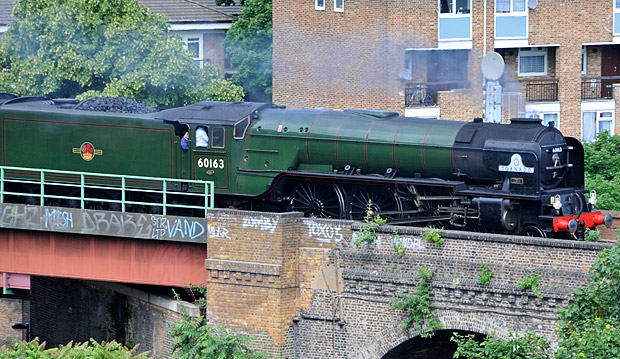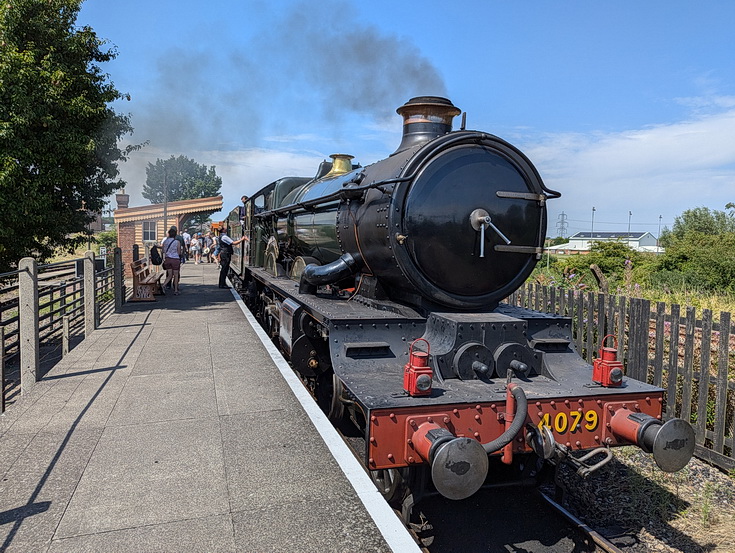

For anyone interested in Britain’s railway heritage, steam engines and signalling (and you can count me in for all three) this is an absolutely brilliant day out.
Located about an hour from central London via Paddington station, the Didcot Railway Centre lets you explore a unique collection of steam locomotives, carriages, wagons, buildings and small artefacts.


Situated on the 21-acre site of a former Great Western Railway engine shed and locomotive stabling point, the living museum offers steam train rides on certain days, along with tons of fascinating exhibits.
Here’s some of the things you can see:


There’s a short branch line connecting the quaint Didcot Halt to a platform, named Burlescombe Station, located next to the transshipment shed.

The lavish carriage interior,


Dating from broad gauge days, this shed was used for transferring goods from broad to “narrow” gauge rolling stock and vice versa.
Designed by Isambard Kingdom Brunel in 1838, broad gauge was used by the Great Western Railway until 1892., with the rails being 7 ft 1⁄4 in (2,140 mm) apart.

A replica brad gauge engine stands on the left hand platform.

The GWR autocoach (or auto-trailer) train arrives.
Designed by the Great Western Railway, these push-pull trains are powered by a steam locomotive and feature a driving cab at one end, allowing the driver to control the train without needing to be in the steam loco cab. This eliminates the need to run the engine round to the other end of the coach at the end of each journey.

Mixed gauge tracks lead out of the station.


A look inside the autcoach.

Arriving at another small halt, with a GWR style ‘pagoda’ hut.
My home village of Rhiwbina in Cardiff used to have something similar.

On Midsummer’s Day, the 24th of June 1914, the poet Edward Thomas made a journey from London to Ledbury on a steam train which stopped at Adlestrop, a tiny settlement on the border between Gloucestershire and Oxfordshire.
The Lambeth-born, Anglo Welsh poet later recalled the sights and sounds of that hot summer afternoon in a rather wonderful short poem called ‘Adlestrop’.

Despite the fact that the entire site is hemmed in by active BR tracks, there’s plenty to see at the Railway Centre.


Carriage restoration works,


Inside the loco shed.


The signalling centre lets you control nearby semaphore signals, which brought me far more pleasure than expected.


More info
Didcot Railway Centre
Next to Didcot railway station
Oxfordshire
Related posts: